Our Story
Where American History Comes to Stay
Long before there was a Gatlinburg, there was a gap in the mountains.
In the summer of 1773, Daniel Boone led the first settlers across the Appalachian Mountains through the Cumberland Gap — adventurers who remained a short six months before hardship sent them back to the Carolinas. Three years later, Boone returned, led another group through the gap, and founded the first permanent settlement west of the mountains. That was the world these cabins were born into.
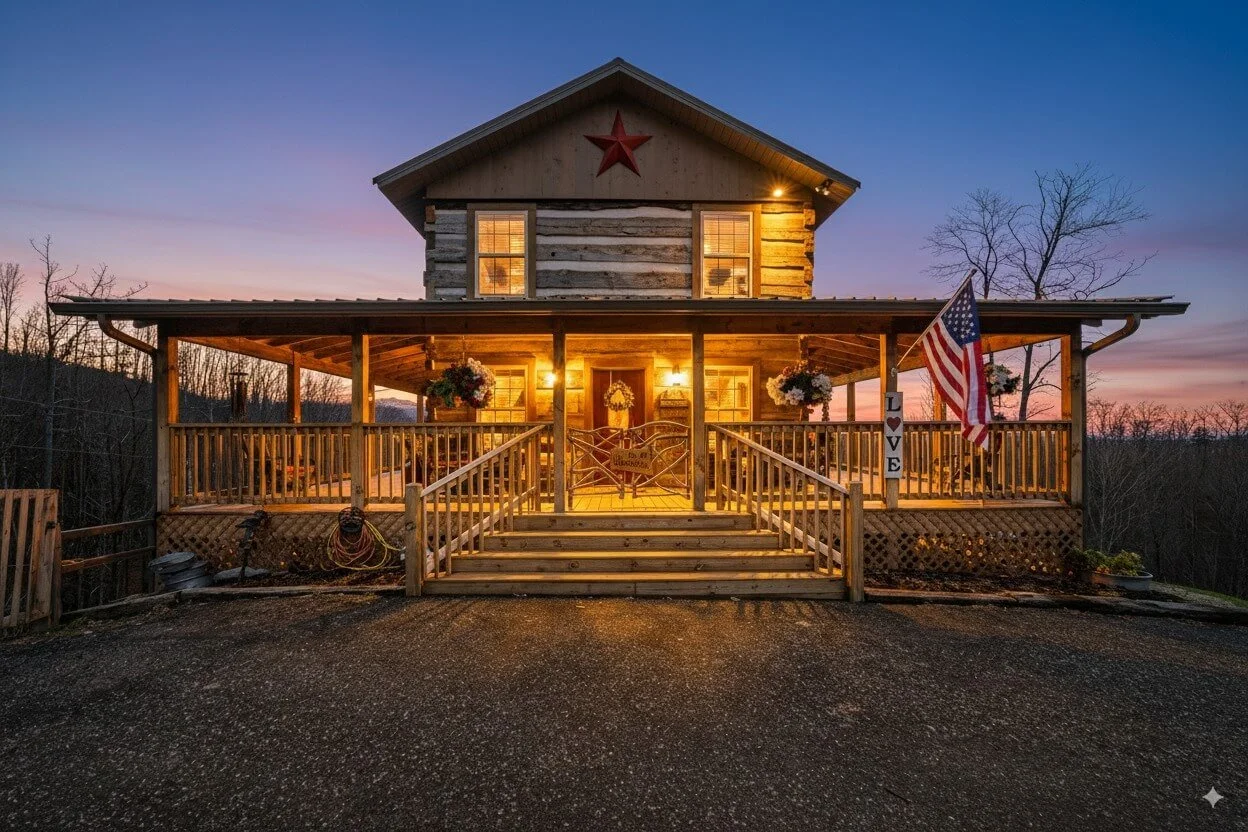
The cabins of Timberidge come primarily from the mountains of East Tennessee, Virginia, Kentucky, and North Carolina. Some are the work of our forefathers — hand-hewn log homes built over two hundred years ago, constructed with native hardwoods using tools no longer made. Each adze mark in the timber is a fingerprint of the craftsman who made it. Each dovetail corner joint is a decision made by a human hand.
When Timberidge was founded, those cabins still stood — scattered across remote mountain land, slowly being reclaimed by the forest. They were found, documented, tagged, disassembled log by log, and trucked to their new home above Gatlinburg. There, they were reconstructed with every modern comfort inside and every hand-hewn wall intact. The small white farmhouse that once anchored a two-hundred-acre farm still sits at the entrance to the property — a quiet marker of everything that came before.
The result is something the Smoky Mountains have never seen: an exclusive community of authentic log homes, where the oldest structures have stood for more than two centuries and every cabin carries the story of the family that first built it.
Then came November 2016.
The wildfires that swept through Gatlinburg were among the deadliest in Tennessee history. The mountain that had sheltered these cabins for decades became a threat. In the days that followed, the Timberidge community faced what those original settlers knew well — loss, uncertainty, and the choice of whether to rebuild.
They rebuilt. Cabins that had survived two centuries were carefully dismantled, transported, and restored to stand again. What the fire could not take was the history cut into every log. That survived.
Today, Timberidge is the only place in the Smoky Mountains — perhaps in all of America — where you can spend the night inside a genuine hand-hewn log home from the 1800s. Not a cabin built to look old. One that is old, saved twice, and still standing.
That is the story of Timberidge. It is as long as your arm, and as old as these mountains.
Why "Authentic" Actually Matters
Search "Gatlinburg log cabin rental" and you'll find dozens of listings calling themselves rustic, historic, or authentic. Almost none of them are.
Here's how to tell the difference — and why it matters for the trip you're about to book.
The Quick Test
Age. A genuine Timberidge cabin is a hand-hewn structure dating to the 1800s. A modern "rustic-style" build was constructed in the last 10–20 years, no matter how it's marketed.
Construction. Ours are shaped by hand with an axe or adze — you can see and feel the tool marks. Modern builds use milled lumber, often with a log-look exterior veneer over standard framing.
Joinery. Genuine hand-hewn cabins use hand-cut dovetail corner joints that hold the structure together without modern fasteners. Faux-rustic builds rely on modern framing techniques, sometimes dressed to look hand-built.
Wood. Ours is native hardwood, aged over a century. Modern builds use new-cut lumber, regardless of finish.
History. A Timberidge cabin is a real structure that stood somewhere else first, with a real past. A modern build has no prior history — the "history" is aesthetic, not factual.
What survives scrutiny. Tool marks, joinery, and a century of wear can't be faked. A faux-rustic finish holds up in photos but not under close inspection.
The Test You Can Run Yourself
When you walk into a genuine hand-hewn cabin, look at the logs themselves, not the décor around them. You're looking for:
Adze and axe marks — shallow, irregular tool marks running across the log's surface. No two are identical, because no two were cut by a machine.
Hand-cut corner joinery — the way the logs lock together at each corner. Hand-hewn joints are individually shaped to fit; you can see the small variations from log to log.
Wood that has actually aged — color, density, and grain that only come from a century of standing, not a stain applied last spring.
A modern build can mimic the look of these things from a distance. None of them hold up to a close look — and that's the test a faux-rustic cabin always fails.
The history is what brings guests here. This is what keeps them coming back — and writing about it. 2,600+ five-star reviews, and counting.
Contact us.
We’d Love to Hear from You Whether you have questions, feedback, or just want to say hello—we’re here and happy to help. Reach out to us using the form below, and we'll get back to you as soon as we can. Your message matters to us.
timberidgecabins.gatlinburg@gmail.com